

How A1 Macedonia’s Three-Pillar Plan is Redefining Telco

How A1 Macedonia’s Three-Pillar Plan is Redefining Telco
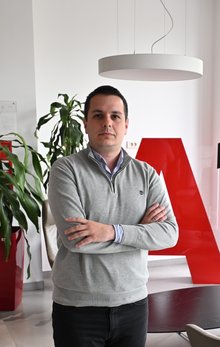
Aleksandar Gichevski is the Head of IT Services and Architecture Unit at A1 Macedonia, what he describes as a proud member of the A1 Group – one of Central and Eastern Europe's leading providers of digital services and communication solutions.
Aleksandar is the lead architect of A1 Macedonia's digital ecosystem, overseeing four specialist units and responsible for the technical blueprints that underpin everything the operator does – from its mobile, fibre and cable networks through to the complex ICT solutions it delivers for the business sector.
Now, with almost 12 years at A1 behind him, Aleksandar describes his position as managing the bridge between business goals and technical execution.
It’s this role, he says, that places him at the intersection of telecommunications and enterprise IT.
This is a space he was drawn to early in his career, driven by a conviction that connectivity is far more than a utility.
“Telecommunications is not just about connectivity anymore,” he says. “It’s the backbone of our modern digital economy. Moving into this intersection felt like a somewhat natural progression.
“The telco world provides the brain and logic, while the telco provides the nervous system. It allows me to work on massive-scale problems that have a direct impact on how people live, work and communicate every single day.”
A1 Macedonia: From merger to modern mobile operator
Aleksander joined A1 Macedonia at a time when the organisation was navigating the complex aftermath of merging three separate operators into one — integrating a cable operator built on DOCSIS and HFC technology, a mobile operator and the systems and cultures that came with each.
He says that it was a consolidation that demanded both technical precision and cultural change, laying the foundations for the lean, modern infrastructure A1 Macedonia operates today.
“It wasn’t just a technical exercise,” he says. “It was about creating a unified, agile environment.
“By streamlining our stack, we have eliminated silos and consolidated architecture to eliminate duplicate systems. We have built a lean infrastructure capable of supporting the next generation of digital services.”
This infrastructure, Aleksandar underlines, is one that is flexible enough to keep pace with what comes next.
An operator for a cloud-based world
Central to A1 Macedonia’s modernisation has been a cloud-first strategy that has seen more than 45% of local IT applications migrate across a hybrid environment, combining the A1 Group-owned Exoscale platform with a local Red Hat OpenShift platform.
Aleksandar and his team have deliberately rejected the lift-and-shift model in favour of genuine transformation – refactoring applications before migration to ensure no technical debt is carried forward.
“We didn't go down the ‘lift and shift’ path,” he explains. “Our approach has been: move it to the cloud, but make it cloud-native first; move it to the cloud, but refactor it first.
“This was a bit slower, for sure, but we are now seeing the benefits. Without technical debt, we can move much faster, reach different scalabilities and open up different opportunities.”
The choice of Exoscale as a 100% European cloud provider also removes what Aleksandar describes as the shadow of concerns around data sovereignty – a non-negotiable consideration for any European telco operating in today’s regulatory environment.
AI, proactive care and the invisible fix
Alongside the cloud programme and a major billing transformation, Aleksandar has led A1 Macedonia’s push into AI – integrating Microsoft Copilot across the workforce and deploying voice bots and internal chatbots to improve both customer experience and employee productivity.
“It's not about replacing developers,” he says of the Copilot rollout. “It’s about removing drudge work. Copilot acts as a force multiplier.
“It allows us, our IT workforce and every other employee of A1 Macedonia to focus on complex problem solving and high-level architecture while the AI handles boilerplate code and documentation in IT terms.”
Perhaps most distinctively, he has overseen the implementation of an end-to-end WiFi service assurance solution that gives A1 Macedonia real-time visibility into the home network environments of its customers.
The aim is to resolve issues before users are even aware a problem exists.
“We are moving away from the era of waiting for a customer to call and complain,” Aleksandar says, “because by the time they pick up the phone to ring our call centre, the damage to the NPS is already done.
“At A1 Macedonia, we have closed this visibility gap by implementing an end-to-end Wi-Fi service assurance solution. This transforms our relationship with the home network and turns it from a blind spot into a strategic asset.”
Looking ahead, Aleksandar sees autonomous network management and predictive maintenance as the next major frontier for the industry – areas where the volume of data generated by telco infrastructure creates a significant opportunity for AI to deliver genuine operational change.
“I’m certain — not just assuming — that predictive network maintenance, autonomous network management and digital twins will be the next big thing in telco,” he says.
His ambition for A1 Macedonia is clear: to complete the shift from traditional telecoms provider to a digital services company at the centre of the Macedonian technology ecosystem — and to do so without standing still for a moment.