
Microsoft Builds 'World’s Largest' AI Data Centre
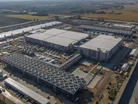
In Mount Pleasant, Wisconsin, Microsoft is completing Fairwater, a facility it calls the world’s most powerful AI data centre. Construction is in its final phase, with operations scheduled to begin in early 2026.
The project represents a US$3.3bn investment, with recruitment already under way for the full-time team who will run the site once it is live. Microsoft has further confirmed a further US$4bn investment to construct a second facility of similar scale, bringing its total commitment in Wisconsin to more than US$7bn.
Engineered for AI at scale
The Fairwater site has been designed specifically to support the training of frontier AI models. It will house hundreds of thousands of Nvidia GPUs configured in clustered formations, connected by fibre optic cable long enough to circle the earth four times.
According to Microsoft, the data centre will deliver 10 times the performance of today’s fastest supercomputers. The level of capability is expected to accelerate breakthroughs in fields such as medicine, manufacturing and scientific research.
Microsoft positions the facility as both a hub for innovation and a catalyst for local development. Construction jobs, long-term IT careers and new training opportunities are all part of the wider economic impact.
A partnership with Gateway Technical College has already established Wisconsin’s first Datacenter Academy, preparing students for specialised roles.
Sustainability at the core of design
Sustainability sits at the centre of Microsoft’s design approach. More than 90% of the facility relies on a closed-loop liquid cooling system that is filled once during construction and then continually recirculated.
The remainder of the site uses outside air cooling, with water only needed in peak heat periods.
Annual water use is expected to be modest, equivalent to a single restaurant’s consumption over a year or the amount a golf course uses in a single summer week.
It has further committed to managing its energy needs responsibly. It is pre-paying for both the energy and infrastructure consumed to ensure prices remain stable for local residents. Every kilowatt hour of fossil fuel power used will be matched with carbon-free energy delivered back to the grid.
Support for the facility includes a 250MW solar project now under construction in Portage County, alongside collaboration with WE Energies to manage transmission and generation. Microsoft is funding ecological restoration projects in Racine and Kenosha counties.
“What sets Microsoft’s infrastructure apart is the relentless pursuit of innovation and sustainability,” says Noelle Walsh, President for Cloud Operations + Innovation at Microsoft.
“Our data centres use advanced closed-loop liquid cooling systems – integrated pipes circulate cold liquid directly into servers, extracting heat efficiently and ensuring zero water waste."
She adds: “Nearly 90% of our data centre capacity uses this system, requiring water only once during construction and continually reusing it with no evaporation losses.
"This breakthrough enables higher rack density and supports the most demanding AI workloads, while dramatically reducing environmental impact.”

Workforce development and local impact
At peak construction, more than 3,000 workers have been employed across trades including electricians, steelworkers and concrete specialists. Once operational, the first data centre will create 500 permanent roles, rising to around 800 after the second site is completed.
The Datacenter Academy is expected to train more than 1,000 students within five years. Together with the University of Wisconsin and local partners, Microsoft has already helped 114,000 people in the state to develop AI skills, including 1,400 residents of Racine County.
Beyond training, it is expanding connectivity. More than 9,300 rural residents have gained access to faster broadband, while 1,200 homes and businesses in Sturtevant have been newly connected.
Microsoft is sponsoring the nation’s first manufacturing-focused AI Co-Innovation Lab at the University of Wisconsin-Milwaukee, supporting firms such as Regal Rexnord and BW Converting to explore AI-driven solutions.
A vision rooted in community
For Brad Smith, Microsoft Vice Chair and President, who grew up in Mount Pleasant, the project represents both personal connection and corporate vision.
“It shows that Wisconsin has not just a longstanding and proud industrial past – it’s helping define the future of American innovation,” he says. “Mount Pleasant isn’t just becoming a hub for AI – it’s becoming a blueprint for how innovation can serve everyone.
"We’re not just investing in an AI data centre; we are investing in a community. And we are investing in a powerful idea: that innovation is for everyone and that we can build the future together – with care for people, place and planet.”

