
IBM and NASA Launch Surya AI to Forecast Solar Weather
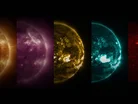
IBM and NASA have introduced Surya, an open-source AI model designed to interpret high-resolution solar data, enabling forecasts of solar weather.
The model is shared openly on Hugging Face, marking a step forward for global researchers and technologists.
The world’s reliance on technologies like GPS, power grids, satellites and telecommunications highlights the growing importance of understanding solar activities.
These technologies are vulnerable to solar flares and coronal mass ejections (CMEs), which can disrupt operations and threaten safety.
Significant economic impacts are projected, with losses potentially reaching US$2.4trn over five years from a single severe solar storm, according to Lloyd's systemic risk analysis.
“Think of this as a weather forecast for space,” says Juan Bernabe-Moreno, Director of IBM Research Europe for the UK and Ireland.
“Just as we work to prepare for hazardous weather events, we need to do the same for solar storms.
“Surya gives us unprecedented capability to anticipate what’s coming and is not just a technological achievement, but a critical step toward protecting our technological civilisation from the star that sustains us.”

Impacts of solar weather
The Sun, positioned approximately 93 million miles away, affects Earth far beyond its distant surface.
Solar activities can damage satellites, pose threats to astronauts and disrupt aviation and agricultural GPS systems.
As space exploration intensifies and reliance on space-based technologies grows, the importance of timely solar weather forecasts increases to protect infrastructure and lives.
Traditional forecasting has grappled with the complexity of solar phenomena, often depending on incomplete satellite views and limited datasets.
This has challenged accuracy, notably for real-time predictions like pinpointing solar flare origins and intensities.
The role of Surya
Surya addresses these limitations using nine years of high-resolution solar imagery from NASA's Solar Dynamics Observatory.
The data set, 10 times larger than typical AI datasets, presents significant technical challenges.
However, it enables the model to achieve exceptional spatial resolution in solar imaging.
Initial evaluations indicate that Surya improves solar flare classification accuracy by 16% compared to earlier models.
Researchers can now forecast solar flares on the sun's surface up to two hours ahead, offering visual predictions for the first time.
Surya's capabilities extend to predicting active regions, solar wind speeds, and solar EUV spectra, crucial for understanding space weather's terrestrial effects.
“We are advancing data-driven science by embedding NASA's deep scientific expertise into cutting-edge AI models,” says Kevin Murphy, Chief Science Data Officer at NASA Headquarters in Washington.
“By developing a foundation model trained on NASA's heliophysics data, we’re making it easier to analyse the complexities of the Sun's behaviour with unprecedented speed and precision.
“This model empowers broader understanding of how solar activity impacts critical systems and technologies that we all rely on here on Earth.”
Advancements in solar weather prediction
By making Surya and its dataset publicly available on Hugging Face, IBM and NASA aim to expedite scientific discoveries and broaden access to solar weather prediction resources.
The largest curated heliophysics dataset now openly invites researchers to innovate, adapt and fortify technological resilience globally.
Surya expands the scope of IBM and NASA's Prithvi models, which address geospatial and weather challenges through AI, furthering their mission to apply state-of-the-art technology to multifaceted scientific challenges.
This collaborative initiative exemplifies the transformative potential of AI in enhancing our understanding and management of the solar weather's expansive impact on Earth-based technological systems.