MWC: Inside Indosat's AI-First Telco Strategy and Expansion
Indosat is redefining its role in the telco sector, moving beyond connectivity to position itself as an AI-led national platform. The operator’s strategy combines network infrastructure with AI, sovereign cloud and localised large language models to deliver what it describes as “AI for all” across Indonesia.
The telecom's transformation builds on its scale, serving close to 200 million customers across 17,000 islands. This footprint underpins its ambition to embed AI across both services and operations.
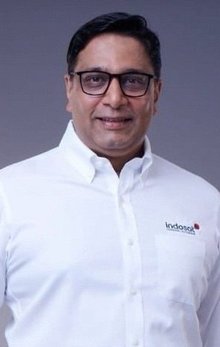
Speaking at Mobile World Congress in Barcelona, Vikram Sinha, President Director and CEO of Indosat, said: “We mean it when we say our larger purpose is empowering Indonesia.”
Building AI into telco infrastructure
Indosat’s strategy takes shape following its merger into Indosat Ooredoo Hutchison, giving it the scale to rethink its role in the telecoms market. The company defines an ‘AI North Star’ built on three key pillars.
- Becoming an AI‑native telco
- Building an AI TechCo cloud play
- Acting as a nation builder for Indonesia’s digital future
A key part of the plan is the expansion of GPU-powered data centres, starting from 10MW of live capacity and targeting up to 1GW by 2030. This positions the operator to support regional AI workloads while aligning compute capacity with network growth.
Vikram makes clear that this expansion remains tied to core performance. “If I am not performing well on my core business, I have no right to start a new business,” he says.
AI is already embedded across operations, from personalised offers to distribution across 300,000 outlets and capex allocation at a grid level. These use cases support growth while improving efficiency across the network.
Sovereign AI and network security
At the centre of Indosat’s approach is Sahabat AI, a sovereign large language model designed around local data and language requirements.
Rather than competing directly with global platforms, the model complements them while focusing on Indonesia-specific use cases. “We are not trying to compete with ChatGPT or Gemini,” Vikram explains.
“We are focused on making sure that it understands all languages. We want to make sure that it understands the cultural nuances and understands the real insights.
“We want to collaborate with ChatGPT and Perplexity, et cetera, at a certain level, but what we want to focus on is the sovereign sensitive data which it is getting trained on and all the local language cultural provision.”
One of the first large-scale deployments is in spam and scam detection, developed with Tala and trained on Indosat’s AI infrastructure. Within six months, the system blocked close to one billion incidents and flags millions of bad actors.
“As a telco, our job is not only to connect, but also to protect,” Vikram said.
“This is the first use case where we are using AI to solve a real problem at scale. Giving core connectivity is no longer what our role is. If I'm giving you connectivity, I need to give you peace of mind that I'm giving you security, too.”
Extending AI to the network edge
Indosat also advanced its AI-Grid concept, moving from centralised AI factories to a distributed model across its network footprint. The goal is to scale towards 55,000 AI-enabled sites at the edge, supported by AI-RAN in collaboration with Nokia and NVIDIA.
This approach allows RAN and AI workloads to share GPU infrastructure across Indosat’s nationwide footprint.
“When we started this journey, it was not about creating more efficiency, but moving up from AI RAN to AI grid,” Vikram says. “That has been the focus. From proof of concept, we are now in the place where we are getting ready to scale up.
“This is a once-in-a-lifetime opportunity for telcos like us to move from just doing connectivity to doing connectivity plus compute, which is intelligence, and to do it at the edge in a sovereign manner.”
Alongside infrastructure, Indosat links its AI strategy to skills and ecosystem development through partnerships with national initiatives and regional centres.
“Our approach is AI for all and we are trying to be the great equaliser,” Vikram says.
He adds: “We’ve been on a journey in terms of democratising intelligence. We very strongly believe that AI is a great equaliser. We are looking at AI from a growth mindset – how it can empower humans, how humans can lead.
“When I talk about AI for Indosat, that has been the approach – investing in talent, helping every employee unlock their full potential and unlock growth. The same is happening at a country level. This has been our journey.”
Company portals

Executives
Vikram Sinha
President Director and CEO