New Glenn Rocket Setback Hits Blue Origin Network Ambitions
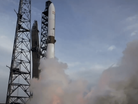
As Blue Origin attempts to close the gap with the world's largest satellite company, SpaceX's Starlink, the company has faced challenges.
The New Glenn GS1 SN2 booster failed to place a satellite into its intended orbit on 19 April, meaning the Federal Aviation Administration had to ground the vehicle.
Since the failed launch, a full mishap investigation by Blue Origin has been underway.
The New Glenn rocket's second stage booster has since returned to Port Canaveral. The FAA has ordered a pause on New Glenn flights until the inquiry is complete, with federal oversight at every stage.
The agency must approve the final report before New Glenn can return to flight.
NASA Spaceflight streamed the return of the second booster to Port Canaveral over social media channels as spectators watched.

What was the mission and the mishap?
The initial incident occurred at Cape Canaveral Space Force Station, where flight operations were halted following the failed launch.
At the centre of the mission was BlueBird 7, a satellite built for AST SpaceMobile, a Texas-based company working on a space-based cellular broadband network.
The concept was straightforward but ambitious: satellites acting as base stations in orbit, connecting directly to standard mobile handsets without the need for specialised equipment. The model sought to fill coverage gaps where traditional telco towers cannot reach.
The New Glenn mission achieved a partial success, marking a historic milestone. Its reusable first-stage booster, named "Never Tell Me The Odds", landed on a platform in the Atlantic.
However, the upper stage failed during the final phase of the journey. According to Blue Origin CEO Dave Limp, early data points to an issue with one of the BE-3U engines, which reportedly didn't generate enough thrust during its second burn.
As a result, the satellite ended up in what engineers describe as an off-nominal orbit – a trajectory too low to support normal operations.
“While we are pleased with the nominal booster recovery, we clearly didn’t deliver the mission our customer wanted, and our team expects,” Blue Origin CEO Dave Limp wrote on X.
Satellites must reach precise orbits to provide consistent coverage and integrate with ground networks. Any deviation risks service gaps or requires costly corrective measures.
Market reaction and regulatory oversight
The impact extended quickly into financial markets.
According to finance reporting firm Seeking Alpha, AST SpaceMobile’s shares dropped by 14% the following day, reflecting investor concern about deployment timelines and network readiness.
Although the company confirmed the loss was insured, the delay comes at a time where the “direct-to-cell” market is becoming crowded as multiple players race to secure partnerships with mobile operators.
The rocket is staying grounded until the FAA confirms that any “system, process or procedure related to the mishap does not affect public safety”.
Regulatory timelines can be as critical as technical fixes for telco providers relying on satellite constellations, shaping when new capacity becomes available.
Competition intensifies in satellite telecoms
The setback unfolds against a backdrop of fierce competition between space and telecom giants.
Blue Origin, founded by Jeff Bezos, aims to close the gap with Elon Musk’s SpaceX, whose Falcon 9 and Falcon Heavy rockets dominate commercial launches.
New Glenn, standing at 98 metres tall, forms a core part of that strategy. It is designed to carry large payloads, including satellites for broadband networks that serve telecom markets.
Blue Origin has planned its own constellation, Project TerraWave, with more than 5,000 satellites.
In parallel, Amazon strengthened its position by acquiring satellite operator Globalstar for US$11.6bn to support its Project Leo network.
Both initiatives target the same goal: global connectivity that complements or competes with terrestrial telecom infrastructure.
SpaceX’s Starlink currently leads, with over 6,000 satellites in orbit. Its early-mover advantage places pressure on rivals to scale quickly, maintain launch reliability and secure partnerships with telecom operators worldwide.
Blue Origin signals confidence despite the failure. “The investigation will allow us to learn from the data and implement the improvements needed to quickly return to flight operations,” Dave noted.
The timeline for that return is still uncertain, and telco operators watching from the ground are now left to weigh the risks and rewards of relying on space-based infrastructure as part of their future networks.






Executives
David Limp
Chief Executive Officer