
MWC 2026: NVIDIA Maps an AI-Native Future for Telco Networks
Telco networks are moving towards an AI-native, software-defined model that supports autonomous operations at scale.
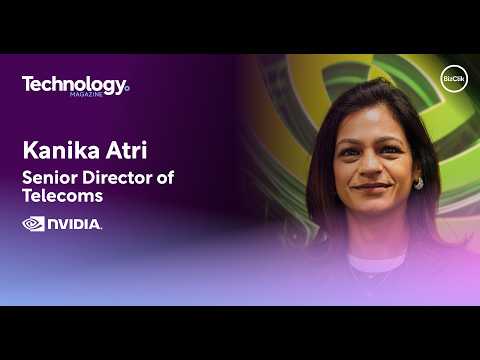
When Kanika Atri, Senior Director of Telecoms at NVIDIA spoke at MWC 2026, she set out how this transition places operators at the centre of both connectivity and intelligence delivery.
“The telecom industry is now dawning on a new role to also become AI service providers,” she said.
“It’s going beyond connectivity and delivering intelligence. AI is actually shaping the future of the industry, both internally and externally.”
6G and the move to software-defined networks
Kanika described 6G as a reset in how networks are designed and upgraded.
Unlike earlier generational changes, which follow hardware cycles, 6G develops within an AI-led environment that requires flexibility and continuous iteration.
“When 5G was defined, AI was not really a thing,” Kanika explained. "But 6G has been born in the AI era."
“This transition is almost discontinuous and revolutionary because it’s not just about what new capabilities 6G will have – it’s a complete architectural transformation.”
At the core of the transformation is a fully software-defined stack. This means that functions such as routing and optimisation are handled through software rather than dedicated hardware systems.
“This means it’s completely decoupled from the hardware,” she added.
“You do not need to wait 10 years to introduce new capabilities. You can move at the pace of software’s continuous innovation.”
“This is a seismic shift. 6G will be built on this new architecture so that it is fully software defined.”
This network revolution opens the door to programmable networks, where capabilities are updated through software releases rather than physical upgrades. It also means that services can be deployed faster.
Autonomous operations and agentic AI
Kanika also spoke on the need for autonomy, which depends on awareness and learning – not just automation, which relies on pre-defined paths and rules.
“Autonomous operations in telco networks is not just a nice to have, it’s going to be essential,” she said, “because the scale at which these networks operate, that complexity is impossible to humanly manage.”
From Kanika's perspective, autonomy means systems that can self-configure, self-optimise and self-heal without constant human input.
“To do that, you need models, you need agents,” Kanika explained. “What we’ve announced in Barcelona are blueprints – basically, recipes for how to take a large language model and train it with telecom network data so that it can speak the telco language.
“Then, on top of that, we’re looking at how you build agents that solve problems. So we’ve also announced some blueprints for energy efficiency. These are things that telcos care about every day.”
AI-RAN progress and the path to intelligent networks
At MWC, Kanika also pointed to AI-RAN as an area where deployment is advancing.
“Nokia has been the MWC highlight for me,” she says. “It’s not even been six months but, in that time, Nokia has ported its software onto NVIDIA’s accelerated infrastructure. It completed its first full end-to-end calls on commercial phones and on mid-band spectrum using commercial radios.
“It’s amazing to see the progress being made with T-Mobile and IndoSat, too."
Looking beyond network performance, Kanika framed telco networks as a foundation for physical AI.
“Networks are not just going to be serving humans as they do today,” she argues. “They’re going to become the fabric for physical AI – millions, maybe billions of robots, sensors, autonomous vehicles and other moving objects.
“The one ubiquitous thing that will connect and serve intelligence to them is going to be an AI-native wireless network. That itself is a growth driver and is how this industry can not only serve others, but also transform itself and become much more profitable.”
In the nearer term, she also pointed to rising demand for AI inference. Existing edge infrastructure, located close to users, gives operators a route to support this demand while building new revenue streams which are tied to AI services.
Company portals

Executives
Kanika Atri
Senior Director, Telecoms | Product Management | Marketing