
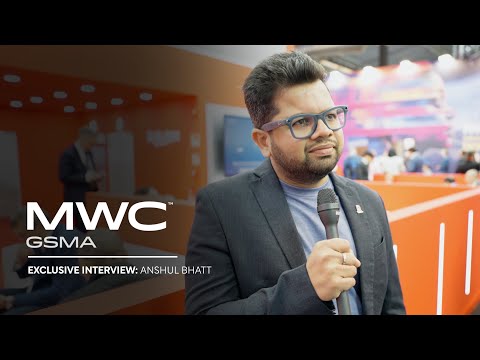
MWC25: Anshul Bhatt on Rakuten Mobile’s Autonomous Networks

Rakuten Mobile has achieved significant growth with its Open RAN network in Japan. This marks a milestone for the company, given that many telco operators are seeking to adopt Open RAN technology.
“It's the world's first commercially scalable, Open RAN deployment,” explains Anshul Bhatt, Chief Product Officer, OSS Business Unit at Rakuten Mobile. “Now that Rakuten Mobile is profitable, it's EBITDA-positive and we are getting a lot of traction from everyone.”
As interest in Open RAN continues to grow across the industry, Rakuten Mobile further establishes its position in network automation as operators continue to seek pathways to reduce operational costs.
“Everyone wants to know about our journey,” Anshul explains. “Another keyword where we are focusing on and everyone wants to know more on is monetisation.”
Transforming traditional site development
A central component of Rakuten Mobile's network strategy is modernising the site management process through their Site Manager platform.
“Rollouts are there to stay, be it 5G rollouts, upgrades and even satellites in future,” Anshul says. “Site management in our view is a key building block for enabling autonomous network operations in order to make sure that you do your building right.”
The company's approach is designed to address inefficiencies in how operators typically handle site development, from planning through to installation and activation. This, in turn, hopes to create opportunities for improvement within the telco industry.
“Site management in our view is a key building block for enabling autonomous network operations.”
“Everything, from network planning, nominal planning, to the entire workflow and site installation, is what comprises the site development process,” Anshul explains. “It's a complex process with a lot of back and forth and typically to our surprise in most of the telcos, it all happens via Excel sheets and emails.
“There is a lot of potential to bring in efficiency, both in terms of expediting the whole process in terms of getting visibility and tracking across the board when it comes to site development lifecycle. So that's where we come in with our site manager approach to modernise and digitalise the whole process.”
Making processes more efficient with an ‘AI site companion’
Rakuten Mobile is implementing AI technologies to assist field engineers and streamline operations across network deployment activities.
“What we are doing is looking at how we can leverage AI to make these processes more efficient,” Anshul says. “It’s about how AI can become a companion to field workers to do their job and make their life easy and also at the same time save some money for the operators deploying it.”
One application involves embedding AI directly into cameras used by field engineers during construction and installation. Anshul explains Rakuten Mobile is also heavily using AI for image processing at site development work and that the solution embeds intelligence into the field equipment itself.
“What we are doing is we put an AI in the camera itself,” he says. “During the construction phase, AI would tell them while they take the photo and tell them if the construction has been completed as per the approved design. We do a lot of intelligent auditing through the camera during site development.
“Another aspect where AI is helping is document management, where AI would read it, understand it and autofill forms - saving around 30 to 40 minutes per site.”
The system also functions as an accessible knowledge base for field staff. Anshul explains that, when a user has a query, they can ask a chatbot who is essentially their companion.
“It’s about how AI can become a companion to field workers to do their job and make their life easy.”
“The LLM behind the scenes will give them an answer from the document data,” he says. “In the world of site management, every leasing company or real estate project will have different kinds of forms, so AI helps us make sense of these documents and save time and money when it comes to deployment.
“What we are looking forward to is an ‘agentic approach’ towards site management. We are now identifying or making our architecture more agentic so that a lot of these jobs and tasks are automated.”
Confronting sustainability demands
Beyond site management innovations, Rakuten is introducing new concepts in network slicing technology that address growing enterprise demand for sustainability in telecommunications.
“On the sustainability side, one of the interesting concepts that we have brought in this year is around network slicing, particularly looking at green slicing,” Anshul shares. “Enterprises are looking forward to leveraging slicing technology, but at the same time they want to meet their sustainability goals. So we have introduced this concept of green slicing, which is essentially an energy efficient network slice.”
“A lot of operators we talked with want to save money, make money and be sustainable in their operation. The autonomous network journey is something that everyone is talking about.”
Explore the latest edition of Mobile Magazine and be part of the conversation at our global conference series, Tech & AI LIVE and Cloud & 5G LIVE. Discover all our upcoming events and secure your tickets today.
Mobile Magazine is a BizClik brand