AI at the Edge: NVIDIA’s Role in Modern Networks
In October, NVIDIA reached a valuation no other company has hit, passing US$5tn.
The firm only reached US$3tn in June 2024, reflecting the scale of its role in AI and edge computing. Its graphics processing units, or GPUs, perform real-time AI at the source of data, reshaping industries from autonomous vehicles to manufacturing.
Edge computing places data processing close to where data is generated, reducing latency and reliance on cloud infrastructure. NVIDIA’s growth shows how AI and edge are closely linked.
The company’s journey begins with valuations in the billions in June 2023, growing to US$4tn in July 2025 and three months later reaching US$5tn.
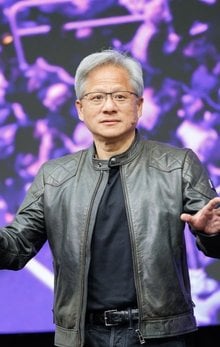
Jensen Huang, Founder, President and CEO of the firm, is showing no signs of slowing down either.
“NVIDIA plans to deliver a total of US$500bn from Rubin and Blackwell in 2025 and 2026”, boosting data centre GPU revenue," he says.
“We are going through a platform shift. That shift is a once-in-a-lifetime opportunity for us to get back into the game for us to start innovating with American technology.”
Speaking at GTC Washington DC, Jensen details partnerships across 6G, supercomputers and autonomous vehicles, reinforcing the surge in NVIDIA’s valuation.
NVIDIA’s data centre business contributes heavily to US GDP growth, with GPUs powering large language models.
Collaborations with Nokia for 5G and Uber for AI logistics strengthen edge strategies.
A US$1bn 6G deal with Nokia uses NVIDIA Aerial RAN Computer (ARC), combining Grace CPU, Blackwell GPU and Mellanox networking to support AI-driven edge connectivity.
Justin Hotard, President and CEO of Nokia, says: “The next leap in telecom isn’t just from 5G to 6G, it’s a fundamental redesign of the network to deliver AI-powered connectivity, capable of processing intelligence from the data centre all the way to the edge.”
Platforms powering AI at the edge
NVIDIA leads with platforms such as Jetson and EGX, enabling AI inference close to data sources.
Jetson modules handle 4K video on 5-10 watts, while EGX pairs CUDA with Kubernetes to support hybrid edge-cloud deployments in safety-critical environments.
CUDA is NVIDIA’s parallel computing platform, allowing software to fully utilise GPU cores for AI calculations and Kubernetes orchestrates these workloads across clusters.
ARC extends AI processing to telecom base stations, enabling software-defined intelligence globally.
Jensen integrates edge computing into AI factories with BlueField-4 chips, which enhance efficiency while supporting energy savings in constrained environments.
NVIDIA’s edge platforms deliver low-latency insights across industries, reducing reliance on the cloud and improving operational performance.
Seagate deploys NVIDIA EGX for disk inspection, achieving 10% throughput gains and 300% ROI by detecting defects beyond human capability.
In mobility, NVIDIA Drive Hyperion and Cosmos support Uber’s 100,000 Level-4 autonomous vehicles by 2027.

Dara Khosrowshahi, CEO of Uber, says: “NVIDIA is the backbone of the AI era and is now fully harnessing that innovation to unleash L4 autonomy at enormous scale, while making it easier for NVIDIA-empowered AVs to be deployed on Uber.
“Autonomous mobility will transform our cities for the better and we’re thrilled to partner with NVIDIA to help make that vision a reality.”
Enterprise, government and infrastructure applications
NVIDIA’s platforms extend to national infrastructure and enterprise AI. Seven Department of Energy supercomputers integrate NVQLink, fusing quantum processors with GPUs via CUDA-Q for hybrid edge simulations.
Palantir leverages NVIDIA’s CUDA-X and Nemotron models in its Ontology platform.
Alex Karp, Co-Founder and CEO of Palantir Technologies, says: “Palantir is focused on deploying AI that delivers immediate, asymmetric value to our customers.
“We are proud to partner with NVIDIA to fuse our AI-driven decision intelligence systems with the world’s most advanced AI infrastructure.”
These partnerships showcase how NVIDIA combines hardware and software to deliver AI at the edge, enabling real-time decision-making and reducing dependency on centralised cloud infrastructure.
By integrating AI processing close to data sources, organisations can achieve efficiency, speed and sustainability gains that were previously impossible.
The company’s success in edge computing forms the foundation of its US$5tn valuation.
From AI-powered factories and autonomous vehicles to telecom networks and national supercomputers, NVIDIA is cementing itself as a leading architect of the AI and edge era.
Its GPUs, platforms and collaborations demonstrate that the company’s influence extends beyond valuation into practical deployments that transform industries worldwide.
Company portals





Executives

Alex Karp
CEO
Dara Khosrowshahi
CEO
Jensen Huang
Founder and CEO
Justin Hotard
President and CEO