
Cisco, Intel and Rice University Drive 6G Signal Precision

Rice University, with support from Cisco, Intel, and several US national laboratories, has developed a method that increases the precision and speed of wireless connections in future 6G networks. The research, published in Nature Communications Engineering, explores how “engineered randomness” can enable almost instantaneous alignment between transmitters and receivers, improving the efficiency of line-of-sight communications in higher-frequency bands.
The next generation of wireless systems will operate at frequencies far beyond those of today’s 5G networks, capable of carrying large volumes of data at significantly higher speeds.
The frequencies, expected to support 6G telecommunications, could enable applications such as untethered virtual reality and real-time industrial sensing. However, higher frequencies face signal attenuation and limited penetration through obstacles, requiring direct alignment between transmission points.
Burak Bilgin, a doctoral researcher at Rice University and the first author of the study, says the new method enables radio systems to pinpoint a signal’s direction within one-tenth of a degree.
“The method we introduce in our paper unlocks extremely rapid angle estimation with unprecedented accuracy,” he says. “This allows wireless links to be rapidly established or recovered with minimal latency.”
Rice, Los Alamos and Sandia develop a metasurface for rapid alignment
The research team, including collaborators from Los Alamos and Sandia National Laboratories, used a thin electronic surface known as a metasurface to test the approach.
When a broadband signal strikes the metasurface, it scatters into a distinct pattern dependent on both frequency and direction. Each angle produces a unique electromagnetic signature, enabling receivers to determine the origin of the signal by comparing it with a pre-recorded reference.
Burak explains the process through an analogy: a lighthouse that emits multiple colours of light, each randomly distributed in different directions.
“The ships around the lighthouse — the wireless receivers — can determine their exact location vis-à-vis the lighthouse based on the set of colours and corresponding intensities they observe,” he says.
The method enables receivers to detect the signal source within trillionths of a second, allowing for real-time wireless alignment.
Earlier systems could only vary the transmitted signal over time or across frequency. The Rice-led approach enables both the production of time-varying and frequency-varying signal patterns.
“Returning to the lighthouse analogy, our work is the first to have both multicolour and time-varying transmission,” Burak says. “Because the random broadcast of colours is rerandomised across different time windows, the ships can make a more accurate estimation with extended observations.”
Data and modelling contributions from Cisco, Intel and Brown University
The experiments require large datasets to model the statistical behaviour of the randomised signals. Cisco and Intel supported the research, alongside theoretical modelling contributions from Brown University. The work combined electromagnetic modelling with physical experimentation to test how engineered randomness can stabilise high-frequency connections.
“It is a study of programmed randomness,” Burak says. “We collected many data to study the average behaviour. It took planning and smart scheduling and the research had its share of unexpected setbacks, such as when the power went out during an experiment.”
The data analysis revealed that the metasurface could deliver directional accuracy roughly ten times better than existing wireless estimation methods. The precision could allow 6G devices to locate and connect with one another almost instantly, reducing latency and improving overall network responsiveness.

Edward Knightly on network evolution and physics
Edward Knightly, Sheafor-Lindsay Professor of Electrical and Computer Engineering and Professor of Computer Science at Rice, says the research shows how fundamental signal physics shapes telecommunications network performance.
“The physics of the signal itself shape what networks can do,” he says. “This study turns that challenge into an opportunity, showing that randomness — when engineered correctly — can make wireless networks faster, smarter and more reliable.”
Company portals



Executives
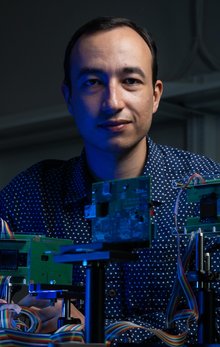
Burak Bilgin
Researcher