
How Britten-Norman Adapts Aircraft for Rural Connectivity
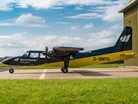
“The sky is the limit” takes on a literal meaning as Britten-Norman advances plans to deliver mobile connectivity from the air.
Working with World Mobile Stratospheric and in cooperation with BT, the company is preparing its BN2T-4S Islander aircraft to support airborne 5G.
It aims to reach remote, underserved communities and restore communications during network outages, which disaster-affected regions may experience.
Instead of relying solely on ground-based towers and fibre, telco operators can use airborne systems to deliver coverage where it is needed most.

Extending coverage to underserved areas
The Islander aircraft is now ready for the installation of a phased-array 5G antenna system, designed to deliver targeted connectivity from above.
A phased-array antenna uses multiple elements to steer signals, which enables operators to direct coverage towards specific locations on the ground.
This is beneficial for remote and rural communities, where building permanent infrastructure can be complex and costly. An aircraft-based system can be deployed as needed, providing mobile access without the same level of physical investment.
For a project this significant, detailed engineering work is required. Britten-Norman produced more than 100 design drawings to support structural analysis, systems integration and certification.
This level of planning ensures that the platform can operate safely while carrying advanced communications systems.
Mark Shipp, Technical Director at Britten-Norman, said: “Reaching the installation phase is a significant milestone for the programme.
“The scale of the design effort reflects the complexity of integrating advanced communications systems onto the Islander platform and demonstrates the depth of engineering capability within Britten-Norman.
“We now look forward to progressing into flight assessment and validating the aircraft’s role in enabling airborne connectivity.”
Installation is now underway at Britten-Norman’s maintenance, repair and overhaul facility, with test flights scheduled for the summer.
Supporting disaster recovery connectivity
Alongside rural coverage, the programme places a strong emphasis on disaster response.
When natural disasters disrupt telco infrastructure, restoring connectivity becomes a priority for emergency services and affected communities.
In these situations, airborne systems can act as temporary network nodes which deliver coverage while ground networks are repaired.
The Islander platform is designed to support this role by providing real-time 5G connectivity in affected regions.
Its ability to remain airborne for extended periods allows it to maintain service across wide areas, helping reconnect users and support coordination.
Richard Deakin, Chief Executive Officer of World Mobile Stratospheric, said: “We are very happy to have reached this important milestone in our joint work with Britten-Norman to deliver connectivity from the sky – both for disaster resilience using the Islander platform and, ultimately, for wider communications coverage from our future stratospheric aircraft.
“Working with the highly capable and professional team at Britten-Norman has proven to be a real pleasure.
“Now we look forward to the next stage in this complex and important programme.”
Flight testing will involve Britten-Norman’s flight operations team working with World Mobile Stratospheric and BT at its Adastral Park research and development facility near Ipswich.
The BN2T-4S Islander’s endurance, payload capability and modular design make it suitable for missions that require both flexibility and reliability.
In this programme, those characteristics support its role as a platform for delivering connectivity to communities and regions where conventional networks fall short.
Company portals



Executives
Mark Shipp
Technical Director
Richard Deakin
Chairperson