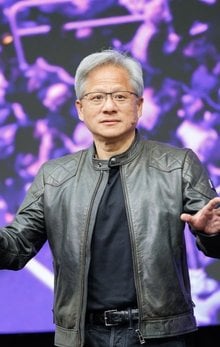
Nvidia CEO Warns of US Lag in AI Infrastructure

Nvidia CEO Jensen Huang warns that the United States risks falling behind China in developing the infrastructure necessary to support artificial intelligence (AI) networks and data centres.
In a conversation with John Hamre, President of the Center for Strategic and International Studies, Jensen highlighted disparities in how rapidly each country can deploy critical computing infrastructure.
He questioned whether the US possesses the necessary power generation and grid readiness to sustain projected growth across hyperscale and telecom networks.
His remarks come amid rising forecasts for large-scale data centre expansion across the United States. With billions of dollars invested in AI workloads, telecom operators and hyperscalers face capacity constraints related to power, construction labour and network interconnection.

Power and build timelines shape network readiness
Jensen says construction speed is emerging as a major factor in the deployment of AI‑ready digital infrastructure. “If you want to build a data centre here in the United States from breaking ground to standing up an AI supercomputer is probably about three years.
“[China] can build a hospital in a weekend.”
He continues that differences in available energy supply are compounding the issue. “China has twice as much energy as we have as a nation and our economy is larger than theirs. Makes no sense to me,” Jensen says.
Rising AI demand is intensifying competition for long‑term power purchase agreements and grid access, affecting both cloud and telecom network planning.
Jensen notes that China’s continued growth in national energy capacity contrasts with plateauing development in the US, exposing a potential bottleneck for multi‑gigawatt campus deployments and next‑generation network interconnects.
Operators planning high‑density data centres or distributed edge sites are prioritising predictable energy availability as much as optical backhaul or compute supply. The shift links the telecom sector’s power strategy directly to national energy policy.
Nvidia maintains chip advantage but warns on deployment
Jensen says that the US continues to lead in AI chip innovation and maintains a strong position in semiconductor design. He notes Nvidia remains “generations ahead” of China in the technology underpinning current AI systems.
However, he warns that this advantage does not offset the structural challenges associated with infrastructure deployment. “Anybody who thinks China can’t manufacture is missing a big idea,” Jensen says.
His comments reflect mounting pressure on US digital infrastructure policy. Telecom and cloud providers may face similar constraints as they expand high‑capacity fibre routes and edge computing networks to support AI workloads.
Without faster build approvals and sustainable power integration, the network layer could face strain as data volumes accelerate.
Jensen references growing political momentum around domestic manufacturing and infrastructure investment.
He says President Donald Trump’s economic policies could “support domestic production and future infrastructure development”, signalling potential regulatory alignment with private‑sector capacity goals.
DataBank and Nvidia outline AI‑driven data demand
Investment in AI‑enabling infrastructure continues to accelerate. Nvidia, alongside telecom‑linked data centre operators, is scaling deployment capacity across the US.
Raul Martynek, CEO of DataBank, says AI compute demand is reshaping capital strategies. “In the US, we think there will be 5 to 7 gigawatts brought online in the coming year to support this seemingly insatiable AI demand,” he says, in comments reported by Fortune.
Raul estimates data centre development costs between US$10m and US$15m per megawatt. Smaller facilities typically require around 40MW, with total capital requirements increasing as operators pursue interconnected, multi‑site expansions.
The projected 5GW to 7GW of new capacity translates to roughly US$50bn to US$105bn in new builds.

For telecom operators, the implications extend beyond the data centre itself. Each site requires scalable optical and IP network capacity, cross‑regional interconnectivity and access to clean and consistent energy.
Jensen’s warning illustrates how energy planning, network resilience and semiconductor supply are converging as core factors shaping the next phase of AI‑era telecommunications infrastructure.


Executives
Jensen Huang
Founder and CEO

Raul Martynek
CEO