Samsung and Nvidia Partner to Build Global AI Megafactory
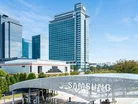
Samsung Electronics has announced the creation of a new AI Megafactory in collaboration with Nvidia.
The initiative introduces artificial intelligence across Samsung’s global manufacturing systems for semiconductors, mobile devices and robotics.
By integrating more than 50,000 Nvidia GPUs, Samsung embeds AI into its entire production network to analyse, predict and optimise operations in real-time.
The AI Factory will integrate every phase of semiconductor manufacturing – including design, process, equipment, operations and quality control – within a single intelligent framework.
AI will manage data generated across chip design and production systems, transforming the manufacturing process into a connected network that operates with continuous feedback and automation.
The collaboration extends a partnership between Samsung and Nvidia that spans more than 25 years.
The two companies first worked together when Samsung supplied DRAM for Nvidia’s early graphics cards, later expanding into foundry partnerships and high-bandwidth memory development.
Samsung and Nvidia collaborate on HBM4 and Omniverse
Samsung and Nvidia continue to develop high-performance memory technology through the HBM4 platform.
Built with Samsung’s 6th-generation 10-nanometre-class DRAM and a 4nm logic base die, HBM4 achieves processing speeds of up to 11 gigabits per second, exceeding the JEDEC standard of 8Gbps.
The companies expect the technology to accelerate AI applications and provide a foundation for AI-driven manufacturing infrastructure.
In addition to HBM4, Samsung plans to continue advancing next-generation memory solutions, including HBM, GDDR and SOCAMM products, as well as expanding its foundry services.
The developments form part of a broader effort to support the scalability of AI technologies across global production environments.
Over the coming years, Samsung will utilise Nvidia-accelerated computing to scale its AI Factory operations.
Through the Nvidia Omniverse libraries, it will build digital twin models of its manufacturing sites.
These virtual environments will replicate physical facilities and processes, enabling predictive maintenance, anomaly detection and optimisation before changes are implemented in real-world conditions.

Samsung will utilise Nvidia’s cuLitho and CUDA-X libraries in its optical proximity correction (OPC) process.
The integration has delivered a 20-fold improvement in computational lithography performance, enhancing the precision of wafer patterning and reducing development cycles.
The OPC process enables AI to predict and correct circuit variations, an essential factor in advanced chip manufacturing.
Expanding digital twin manufacturing with Nvidia technology
Samsung plans to extend its AI Factory infrastructure to global manufacturing hubs, including its facility in Taylor, USA.
It will deploy Nvidia’s accelerated computing and digital twin technologies to connect production systems across its memory, logic, foundry and advanced packaging divisions.
The collaboration involves working with electronic design automation (EDA) partners to develop GPU-accelerated EDA tools and design technologies.
By using Nvidia’s Omniverse libraries, Samsung can visualise full fab operations within a digital environment, ensuring that operational data is continuously analysed and simulated for performance optimisation.
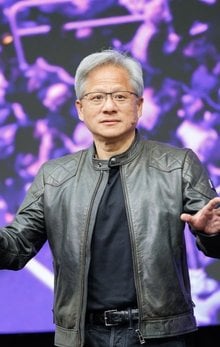
Jensen Huang, Founder and CEO of Nvidia, says: “We are at the dawn of the AI industrial revolution – a new era that will redefine how the world designs, builds and manufactures.”
It illustrates Nvidia’s role in powering the large-scale AI infrastructure to revolutionise manufacturing.
The AI Factory represents Samsung’s shift toward a data-centric manufacturing approach, where automation and AI analytics integrate across every production layer.
The initiative aims to unify manufacturing intelligence from semiconductor design through to robotics assembly and logistics.
Samsung advances AI robotics with Nvidia platforms
Beyond semiconductors, Samsung continues to apply Nvidia technology across robotics and generative AI development.
The company develops proprietary AI models built on Nvidia accelerated computing and the Megatron framework.
The model powers more than 400 million Samsung devices and demonstrates advanced reasoning capabilities in real-time translation, multilingual interaction and intelligent summarisation.
In robotics, Samsung uses the Nvidia RTX PRO 6000 Blackwell Server Edition to enhance automation and humanoid robotics.
The platform supports AI-based reasoning and autonomy in physical applications, bridging virtual simulations and real-world robot data.
Using Nvidia Jetson Thor, Samsung enables real-time AI processing for robotics, supporting task execution and safety functions.
The combination allows robots to analyse their environment, make operational decisions and act autonomously within manufacturing settings.
Samsung plans to integrate these systems into its AI Factory and roll them out across its global production operations.
Samsung and Nvidia explore AI-RAN network integration
Samsung is working with Nvidia, Korean telecommunications providers, universities and research institutions to advance AI-RAN development.
AI-RAN integrates AI computing within mobile network infrastructure, enabling physical and agentic AI systems, such as robots, drones and industrial automation; to process data and make inferences at the network edge.
The approach enables AI-enabled machines to perform operations in real time closer to where data is generated, rather than relying on distant cloud processing.
The design supports applications that need immediate responses, such as factory automation and connected robotics.
The initiative builds on a proof-of-concept completed by Samsung and Nvidia in 2024, in which Samsung’s software-based network was integrated with Nvidia’s GPU technology to demonstrate AI-RAN performance.
The companies plan to continue expanding their collaboration in the area, strengthening the intersection between AI and mobile network infrastructure.
A Samsung spokesperson states that these developments align with the company’s strategy to expand AI-driven manufacturing and connectivity across its ecosystem.
“Our long-term collaboration with Nvidia allows us to create a more intelligent manufacturing foundation while advancing technologies that connect industries and consumers through AI,” the spokesperson says.

Executives
Jensen Huang
Founder and CEO