VAR's High-Stakes Call for Resilient Telco Networks

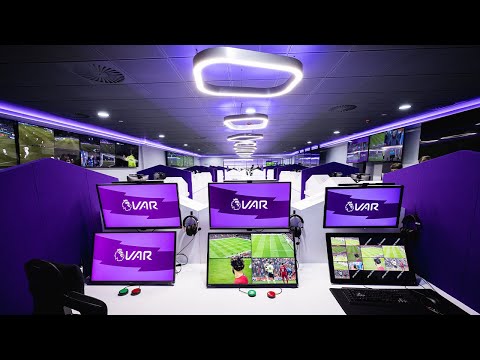
The Video Assistant Referee (VAR) system has become a mission-critical component of modern football. In this high-stakes application, officiating accuracy and game integrity depend entirely on the performance of the underlying network. While fans and pundits debate its impact on the game’s flow, for the telecommunications industry, VAR represents a powerful case study in delivering high-availability, low-latency video and data services.
The strategic shift from on-site operations to centralised video operation rooms (VORs) has created a significant and specialised market, placing network providers at the very heart of officiating technology.
The centralisation challenge: From stadium to hub
The evolution of VAR architecture reveals a clear trend: leagues are moving away from decentralised, in-stadium VORs towards single, centralised hubs.
The English Premier League operates from Stockley Park in London, La Liga from its VOR (Video Operations Room) at the Ciudad del Fútbol de Las Rozas in Madrid and the Bundesliga from the Video Assist Center (VAC) in Cologne.
A centralised model offers efficiencies in expertise and equipment but places an enormous burden on the vast area network. It transforms the connectivity challenge from a local-area problem into a national-scale, mission-critical network deployment.
Successfully connecting every stadium to a central hub means a dedicated, resilient fibre-optic network capable of handling immense data loads with minimal delay. However, the pursuit of speed necessitates a nuanced understanding of what is physically possible.
According to Andy Rayner, CTO of global broadcast technology provider Appear, the conversation must shift from an impossible ideal to an engineered reality.
“Zero latency is physically not possible because the speed of light in fibre is only 200 kilometres per millisecond. So if you’re 200 kilometres away, then one millisecond is the completely non-negotiable law of physics,” Andy explains.
The true priority for a system like VAR is not absolute speed, but unwavering predictability across every data stream. “Very, very low latency is not necessary. Consistent and latency alignment is important, as is the return channel as well.”
Building a resilient, high-bandwidth backbone
To achieve the consistency Andy describes, the network backbone must be both robust and resilient. A single uncompressed HD video channel from a camera demands approximately 150-200 Mbps of bandwidth.
With dozens of camera feeds transmitted simultaneously from a single venue, the aggregate bandwidth becomes substantial. For major stadiums, a network resilience of 99.999% is recommended, as any single point of failure could disrupt an event-critical system and undermine the competition’s integrity.
Achieving the necessary level of resilience involves deploying spatial diversity – sending signals via two geographically separate routes – and using specific industry standards to manage the handover.
“The very best technique to use this is a technique called 2022 dash seven, which in technology terms is what we call merging at the RTP layer,” Andy notes. “That means if you’ve got two dual diverse physical routes from the location to the destination, then you can apply the technology and it seamlessly merges the two flows.”
It ensures that any disruption on one path has no impact on the final signal.
As resolutions move towards 4K and beyond, managing the trade-off between bandwidth costs and image quality becomes critical. “The bigger the spatial image, the more efficiency you get in a newer compression. So if you’re going 4K, then I would say HEVC is the compression of choice. It will be foolish not to use HEVC for that,” says Andy.
Global case studies: Telcos in the VAR ecosystem
Across the world, major telcos have become indispensable partners in the VAR ecosystem, providing the foundational connectivity that makes centralised officiating possible.
In Spain’s La Liga, Telefónica delivers and manages the contribution network for match feeds, partnering with broadcast technology firm Appear for the core platform. “We are honoured that LaLiga has selected Telefónica Servicios Audiovisuales to manage the contribution and distribution of its premium soccer content,” said Jose Luis García Cabrera, COO at TSA.
“With the deployment of Appear’s industry-leading compression solutions, we are able to offer LaLiga the most technically advanced and powerful solutions on the market today.
This project comes as a valuable addition to the comprehensive solutions we have already been delivering for top-tier sports environments — including fixed port networks, AV networks in stadiums, press rooms, production equipment, IP ST2110-based stadiums or show control systems, amongst others.”
Germany’s Bundesliga, meanwhile, relies on a fibre-optic network operated by Sportcast, a subsidiary of the league, with regional provider NetCologne supporting the connectivity to its central hub.
In Scotland, BT provides the high-capacity network that supports VAR operations for the Scottish Premiership, connecting all top-flight grounds to a central operations centre.
The synchronisation challenge and the broader tech stack
Beyond raw bandwidth and resilience, the network must support a sophisticated and perfectly synchronised ecosystem of data sources.
Professional VAR systems predominantly rely on cameras with uncompressed Serial Digital Interface (SDI) outputs to avoid the latency and visual artefacts introduced by IP camera compression.
In addition, the ‘smart’ football adds another layer of data, with an integrated Inertial Measurement Unit (IMU) capturing the ball’s motion 500 times per second to provide the exact “kick point” for offside decisions.
Ensuring every camera, microphone and sensor feed is perfectly time-aligned is a significant industry-wide challenge. According to Andy, it needs robust metadata from the point of acquisition, a standard that is still evolving. “As an industry we’ve got more work to do there to get that fully standardised,” he says.
The drive for technological perfection is a response to undeniable market demand.
Neil Swarbrick, the former head of VAR for the Premier League, defended the VAR system by saying it's "here to stay" and that fans need to "just live with it, just grow with it". He has further highlighted that decision accuracy has improved and that VAR is an evolving process.
Future trajectories and new opportunities
The technological demands of VAR are set to increase, creating new opportunities for network providers. The broader adoption of Semi-Automated Offside Technology (SAOT) in the Premier League is the next frontier.
SAOT fuses data from limb-tracking cameras with the in-ball sensor, needing immense real-time processing and network capacity to deliver faster decisions.
As former referee Pierluigi Collina stated, the technology makes decisions “faster” and “more accurate,” directly addressing VAR’s primary criticisms and reinforcing the need for high-performance networks.

Furthermore, governing bodies are trialling live in-stadium and broadcast announcements from referees to improve transparency.
The success of such initiatives will rely on seamless integration with stadium PA and broadcast systems, opening another avenue for specialised communication solution providers. Christian Holzer, Managing Director of VAR provider Sportec Solutions, frames the mission as creating a “new paradigm in centralised, league-controlled soccer technology.
“Referees never asked for VAR,” he said, “the fans asked for it, the players asked for it, the coaches asked for it.”
The VAR system has fundamentally altered professional football and in doing so, has created a new, non-negotiable dependency on high-performance telecommunications.
The move to centralised operations has cemented the role of network providers as critical enablers of modern officiating.
For the telco industry, VAR is more than just a technological curiosity; it is a high-visibility demonstration of the power to deliver resilient, consistent and high-bandwidth services that are essential to the integrity of a multi-billion-pound global industry.
As officiating technology becomes increasingly automated and data-intensive, the role of the network will only grow more crucial, ensuring a sustained market for telcos capable of meeting these exacting demands.
Telefónica Taps Appear Technology for La Liga’s Next-Generation Broadcast Contribution Network
Spanish telecommunications group Telefónica is delivering and managing La Liga’s new broadcast contribution network, selecting Norwegian firm Appear to provide the core technology.
The new system is pivotal for Spanish football, as it handles the transport of live match feeds from every stadium to central production hubs.
Telefónica Servicios Audiovisuales (TSA) has deployed Appear’s X Platform to manage more than 200 high-quality video feeds.
The state-of-the-art infrastructure ensures reliable delivery from the grounds to La Liga’s Master Control Room in Madrid and subsequently to rights-holding broadcasters worldwide.
The partnership represents a significant technological upgrade for the league. The platform currently supports 1080p HDR broadcasts but is future-proofed with a clear path to Ultra High Definition (UHD) and other emerging standards.
It ensures La Liga can maintain its position as a top-tier global sports broadcast. Telefónica’s deep involvement, both as a network provider and a key domestic broadcaster, cements its crucial role in bringing Spanish football to a global audience.
Company portals



Executives
Andrew Rayner
Chief Technology Officer