
How Apple’s Robot Daisy Helps Recycle Mobile Tech Waste
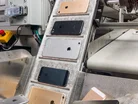
Apple employs more than 166,000 people worldwide, but one of its most efficient team members is not a person.
Daisy is a robot that lives in a warehouse in Austin, Texas, where she takes apart old iPhones with precision.
She blasts each battery with -80°C air to freeze it, then punches out screws and pulls the phone apart.
In 11 seconds, Daisy transforms a used device into separate parts, ready to be reused. She is part of Apple’s robotic workforce focused on reducing electronic waste or e-waste – discarded tech products that often end up in landfill or incinerators.
Amazon's robot fleet built to recycle
Daisy leads a team that includes Dave and Taz – robots designed in-house to help solve one of the electronics industry’s biggest environmental problems: what to do with old devices.
Apple builds these machines at its Material Recovery Lab in Austin, created to find better ways to recover valuable materials.
The standard method of recycling involves shredding devices into a mixture of plastic, metal and glass.
That destroys rare materials like tungsten and rare earth elements, which are used in phone components. Apple’s system avoids this waste by taking phones apart more carefully.
Lisa Jackson, Apple’s Vice President of Environment, Policy and Social Initiatives says: “Advanced recycling must become an important part of the electronics supply chain and Apple is pioneering a new path to help push our industry forward.”
Daisy can take apart 23 iPhone models, working through 200 units per hour. Unlike standard recyclers, she separates parts in a way that retains the quality of the materials.
Copper pulled from old phones is pure enough to be sold back to suppliers. Cobalt is recovered from batteries and reused in new Apple batteries.
This forms what Apple calls a “closed-loop” – a supply chain where materials from old devices go directly into making new ones.
It reduces the need to mine for raw resources, which requires more energy and creates more carbon emissions.
Specialist work from Dave and Taz
Dave and Taz focus on individual components.
Dave was introduced in 2020 to extract materials from the Taptic Engine, the part that provides vibrations in the iPhone.
Once Daisy removes this module, Dave opens it to recover rare earth magnets and tungsten.
Taz, added in 2022, is Apple’s answer to the limitations of shredding.
Unlike traditional shredders that destroy everything, Taz uses a method that separates magnets from audio modules while keeping the material intact. This makes it easier to recover and reuse.
Together, Daisy, Dave and Taz handle different stages of the recycling process, targeting specific materials and keeping them in usable condition.
Their work allows Apple to reduce waste and improve material recovery from returned products.

Consumers provide the supply
Apple relies on trade-ins and recycling schemes to keep the robots working. Each iPhone returned at an Apple Store could end up on Daisy’s table.
These programmes are not about boosting sales but feeding the Material Recovery Lab with old devices.
Apple estimates that users keep their iPhones for around three years, which it uses as a model for its environmental impact. By reclaiming devices at the end of that cycle, it can retrieve parts that still hold value.
In 2021, 20% of all material used in Apple products comes from recycled sources. Today, 99% of the rare earth elements used in Apple’s magnets are recycled – up from nearly zero just a few years earlier.
This all contributes to Apple’s 2030 pledge – a commitment to being carbon neutral across its supply chain and product life cycle by the end of the decade.
Using recycled aluminium in the MacBook Air, for example, cuts its carbon footprint nearly in half.
For Apple, the future of tech is not just about innovation – it’s about disassembly. Daisy, Dave and Taz show that breaking down devices can be just as important as building them.
Company portals

Executives

Lisa Jackson
Vice President, Environment, Policy and Social Initiatives