
How Vodafone INER is Transforming Emergency Connectivity
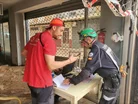
Since its inception in 2012, Vodafone Foundation’s Instant Network Emergency Response (INER) has played a vital role in disaster relief efforts, delivering rapid and reliable connectivity in the most challenging of circumstances.
Originally developed to restore communications during humanitarian crises, INER supports aid agencies, first responders and displaced communities by providing life-saving mobile and internet access.
The first deployment followed a typhoon in the Philippines, using a portable 2G network. The outcome was a proof of concept that changed industry perceptions, demonstrating that mobile infrastructure could be deployed rapidly and effectively in disaster zones.

From 2G to satellite: evolving to meet modern demands
As smartphones proliferated globally, demand shifted from voice-only networks to services that could support messaging apps like WhatsApp and Facebook Messenger.
Vodafone’s technical volunteers in Hungary rose to the challenge, developing upgraded 3G and 4G solutions. The enhancements enabled survivors to reach their families and allowed humanitarian teams to communicate more effectively.
However, early iterations faced challenges in deployment speed and legal restrictions across jurisdictions.
That changed significantly with the introduction of Vodafone Foundation’s Instant Wi-Fi kits in 2017. These lightweight, portable systems offer near-instant deployment—becoming operational within minutes—overcoming earlier logistical hurdles. In disaster response, where the first 72 hours are critical, the shift proved pivotal.
Satellite connectivity expands reach
The integration of Low Earth Orbit (LEO) satellite services, such as Starlink, has further elevated INER’s capabilities.
The technologies now provide affordable, high-speed internet in areas where conventional connectivity is either non-existent or severely damaged. In regions where LEO services are licensed, they represent a step-change in enabling access at scale.
Vodafone Foundation is monitoring developments such as AST SpaceMobile’s satellite-to-phone technology, which could eliminate the need for ground-based infrastructure altogether, offering truly global coverage and enhancing the flexibility of emergency telecoms response.
Volunteers at the core of innovation
At the heart of INER’s success are Vodafone’s skilled and committed volunteers.

Their involvement extends from initial R&D through to live deployments in disaster zones, learning with each mission and applying insights to improve the programme. Their dedication has shaped INER into what it is today: a fusion of cutting-edge technology and real-world experience.
“This support is something that we at Vodafone Foundation have never taken for granted and continue to be extremely appreciative of,” a Foundation spokesperson remarked.
From emergency response to community resilience
While INER continues to lead emergency response efforts, its mission has expanded to include preparedness and local capacity-building.
In Saint Martin, Vodafone Foundation worked with the local Red Cross to deliver and train teams on three Instant Wi-Fi kits. Now, in the event of a future hurricane, local responders are equipped to act immediately—without needing to wait for external support.
By shifting from purely reactive deployments to enabling community ownership of communications infrastructure, INER is helping to embed resilience and reduce response times in high-risk areas.